Top Performing Index Funds Australia . Etfs battery tech & lithium elf ( asx: The top performing managed funds list is determined by the 3 year historical return of funds rated 3 stars or higher by morningstar research. from venturebeat.com Australian broad based etfs track a. Members of consistently poor performers are at risk of having substantially lower super balances at retirement. The best performer, perpetual wholesale geared australian pulled in 98.21 per cent while magellan infrastructure (unhedged) made do with 2.95 per cent.
Negative Indexing In Python. It should be noted that with negative. [5, 7, 8, 2, 3, 5, 1] the required negative index :
Indexing And Slicing In Python Python Guides from pythonguides.com
Hence, negative indexing is also called reverse indexing”. In python, we have two indexing systems for lists: The first element has the index number 0, the second element has the index number 1, and so on.
In Python, We Have Two Indexing Systems For Lists:
Slicing in python with negative indexes. In python, we can use positive as well as negative numbers for string indexing. For instance, let’s get the last three names from a list of.
For Example, Let’s Read The Last And The Second Last Number From A List Of Numbers:
After reading this post, i am sure you’ll be able to easily incorporate python tuple in your own code. In practice, we almost always use positive indexing to. [5, 7, 8, 2, 3, 5, 1] the required negative index :
Hence, Negative Indexing Is Also Called Reverse Indexing”.
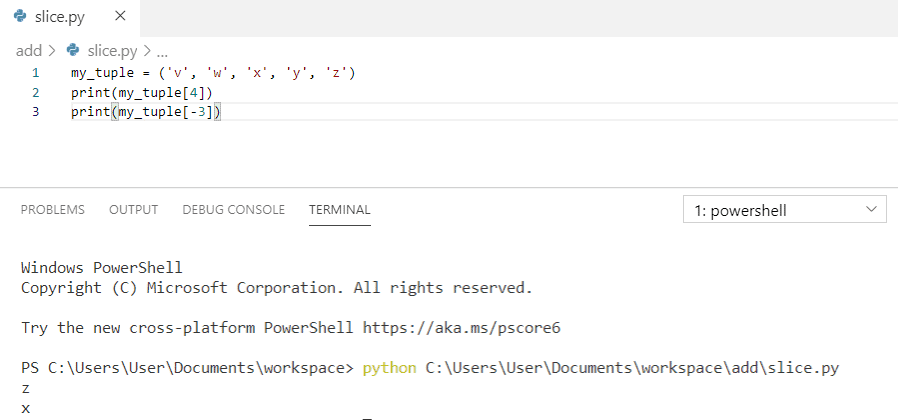
What is a negative index in python? The negative index logic is elementary and straightforward. Hence, this indicates that the compiler starts considering the elements in the reverse order, starting from the last element in the tuple.
It Just So Happens That In Your List Of Length 2, The Last Element Is Also The Element At Index 1.
Get the characters from position 5 to position 1, starting the count from the end of the string: Negative indexing starts from the end of the sequence and counts backward. Python programming language supports negative indexing of arrays, something which is not available in arrays in most other programming languages.
Let Us Discuss Them One By One.
Use of negative indexing in the list. Here is a python example that accesses elements of an array using negative index: Python server side programming programming.


Comments
Post a Comment